

Optimization of UAV Smoke Screen Shielding Strategies Based on Discrete Viewing Cone Theory
The project was developed around a five-question task concerning "UAV collaborative deployment of smoke screen projectiles to interfere with missile observation," forming a complete modeling pipeline from discrete viewing cone shielding determinationArrived to MISOCP and parallel heuristic optimization. Under a unified constraint framework, the key shielding duration results for Questions 1 to 5 were obtained. 1.405 s / 4.665 s / 6.712 s / 11.630 s / 26.954 s。
Abstract
This project addresses the problem of "true target shielding under continuous missile observation" by constructing a computable and scalable multi-UAV collaborative optimization framework. The core approach involves converting continuous viewing cones into discrete sets of sightlines, using the shortest distance from the smoke screen sphere center to the sightline segment to determine "complete shielding." Subsequently, grid-based parallel search and Mixed-Integer Second-Order Cone Programming are introduced in scenarios such as single-UAV single-projectile, single-UAV three-projectile, three-UAV single-projectile, and five-UAV multi-projectile configurations, ultimately achieving an increase in total shielding duration under multiple constraints.
Competition Background and Personal Responsibilities
Core Objective of the Competition Problem
During the missile's flight toward the decoy target, UAVs deploy smoke screen projectiles to ensure that the true target remains in a state of "complete shielding" for as long as possible.
Multi-layer Task Progression
Starting from the single-missile engagement duration calculation in Problem 1, the task progressively expands to the coordinated scheduling of five aircraft with multiple missiles and multiple targets in Problem 5, with continuously increasing decision dimensions and coupling complexity.
My Contributions
Served as team leader, responsible for the design of the main modeling framework, key derivations, implementation of the Python solver, result validation, and final integration of the full paper.
Engineering Output
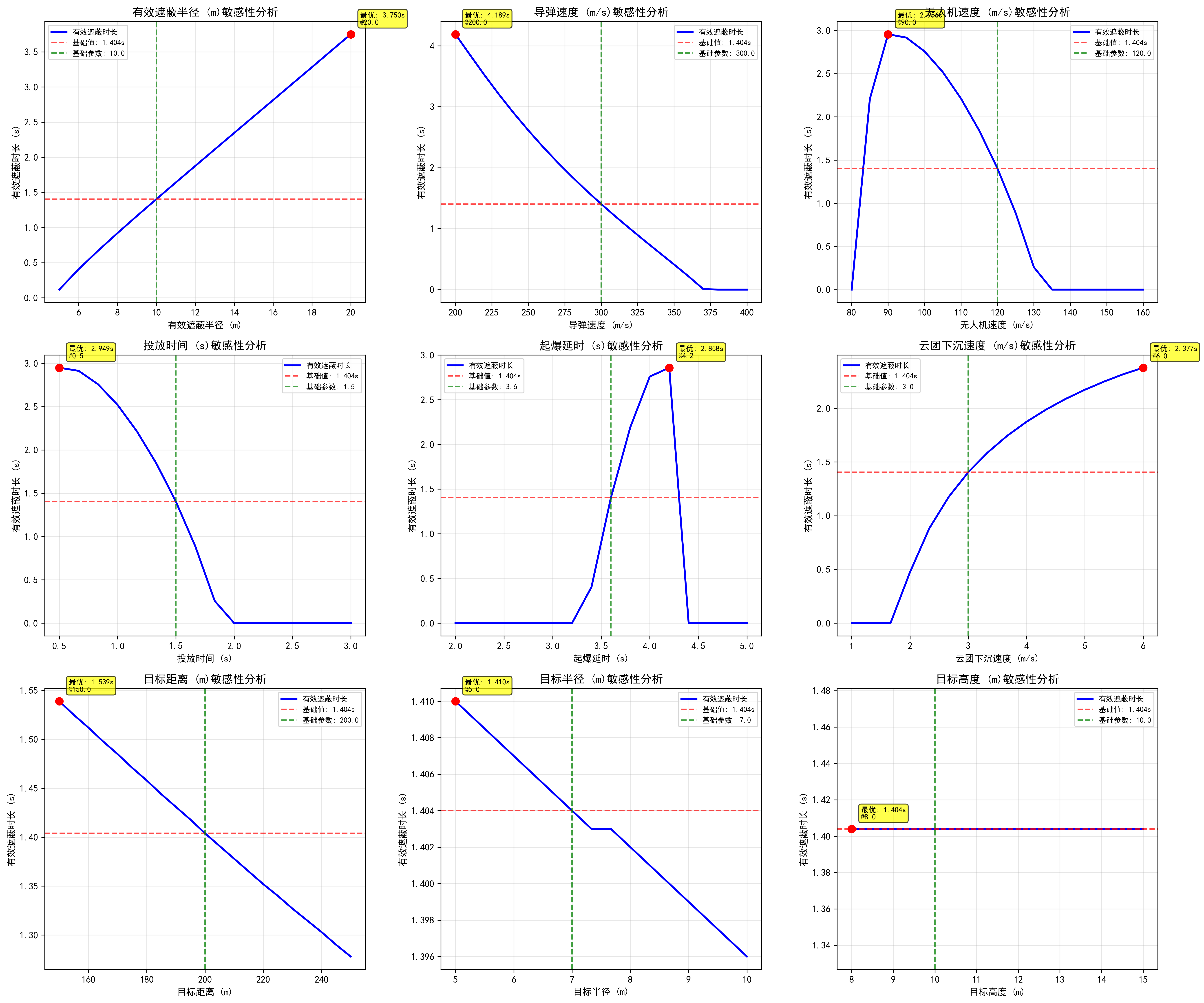
Integrated the judgment module, search module, and visualization module into a unified pipeline, supporting parameter sensitivity analysis, scheme comparison, and result reproducibility experiments.
Methodological Framework
discrete viewing cone shielding determination
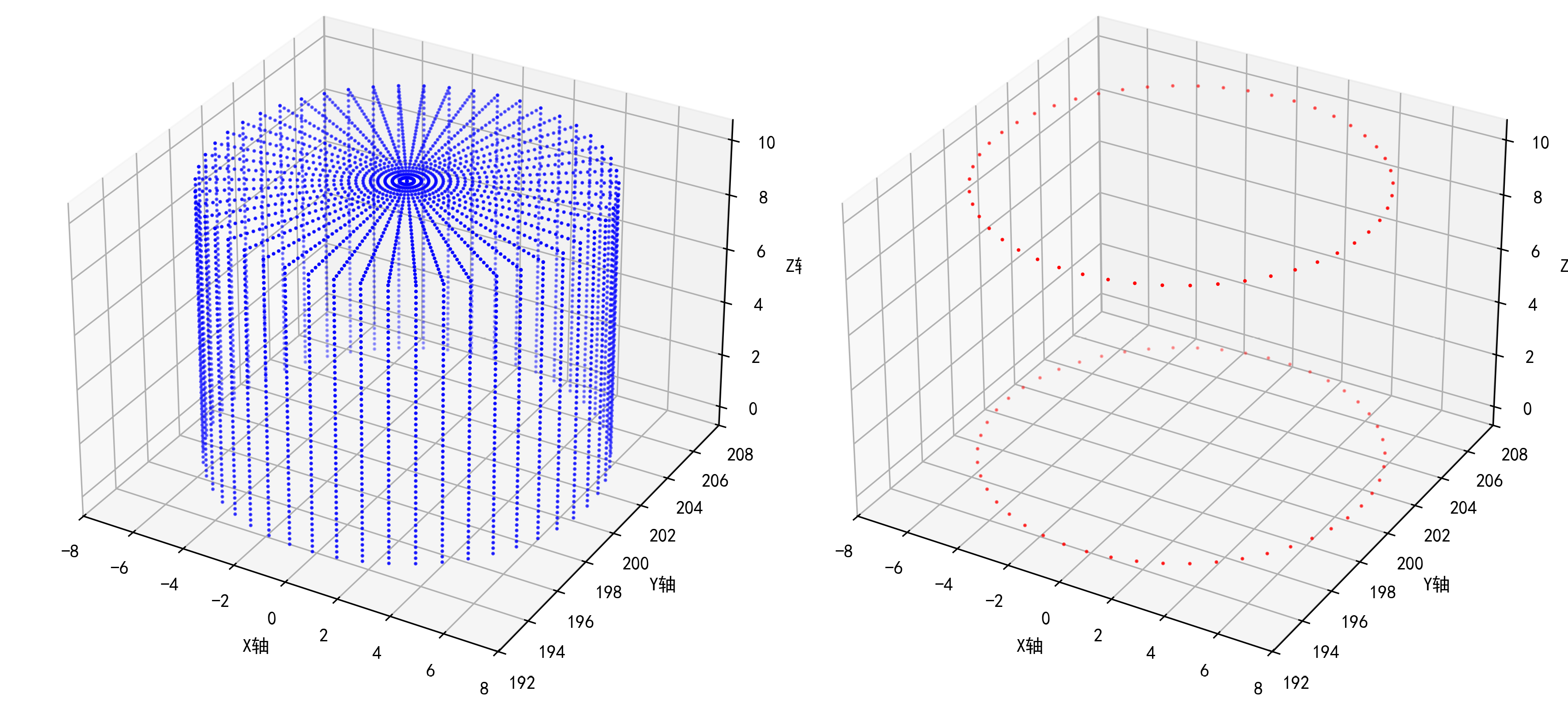
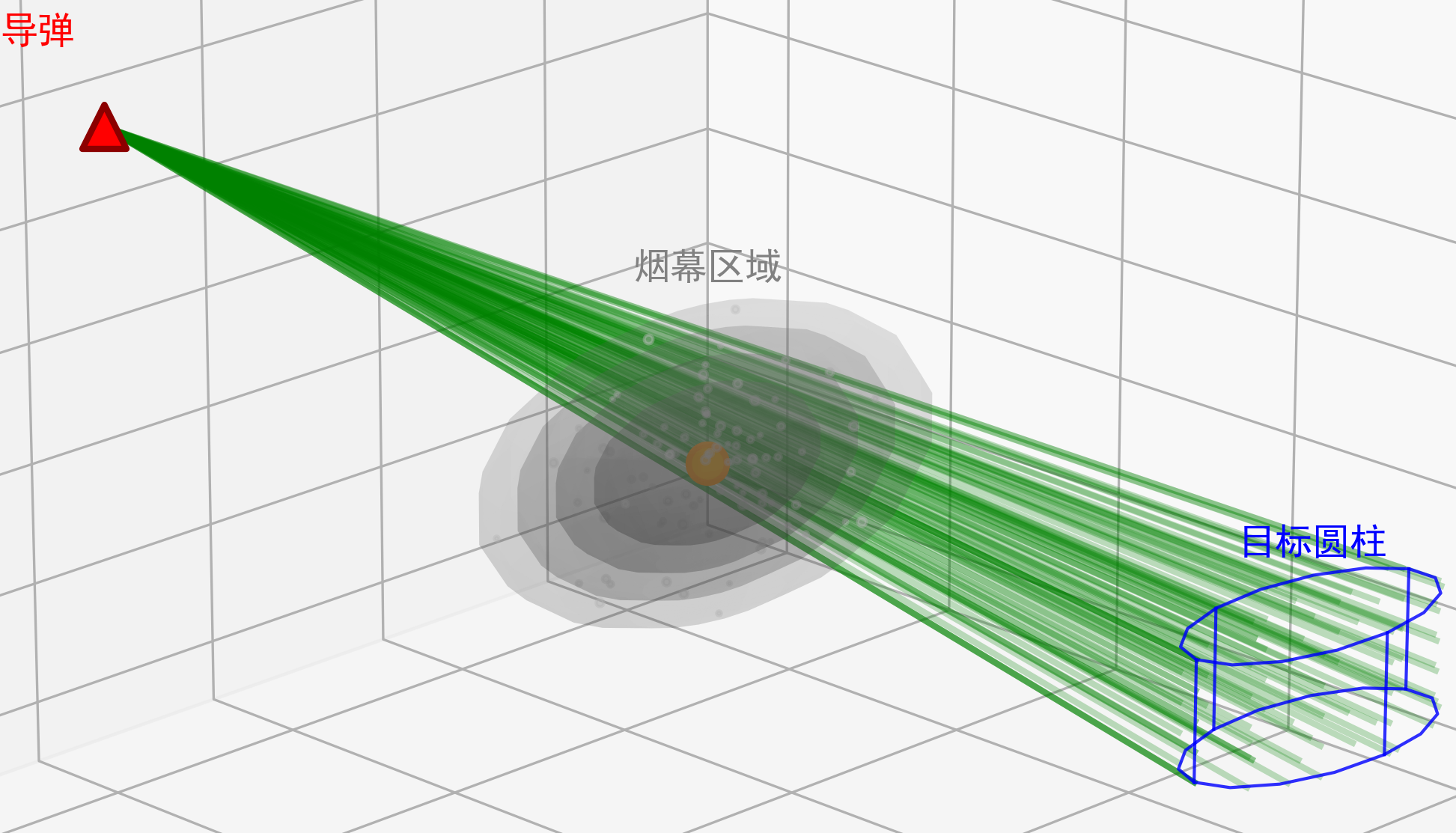
Discretized the continuous observation rays from the missile to the target cylinder, and determined whether complete occlusion occurs at a given time step based on the condition that the shortest distance from the smoke screen sphere center to the line-of-sight segment is less than or equal to the effective radius.
Coarse and Fine Grid Parallel Search
Conducted two-level optimization (coarse and fine search) over variables such as heading angle, velocity, release time, and fuse delay, and accelerated candidate solution screening through multi-process parallelization.
Unified MISOCP Modeling
In Problems 3 to 5, logical constraints such as "at least one smoke screen is effective" and "all lines of sight are blocked" were transformed into a Mixed-Integer Second-Order Cone Programming formulation.
Greedy Scheduling and Joint Combination
After fixing heading and velocity, a greedy scheduling of three missiles and a Cartesian combination of top-K schemes from multiple aircraft were employed to maximize the total duration of the union of overlapping smoke screen intervals.
Overview of Results for the Five Questions
The following summarizes the key indicators and representative parameters for the five problems in the paper. All numerical values are taken from the final version of the competition paper and are consistent with the submitted manuscript.
| Problem | Objective and Method | Key Results | Representative Parameters / Conclusions |
|---|---|---|---|
| Problem 1 | Calculation of effective occlusion duration for a single aircraft with a single missile; construction of a discrete cone-of-vision model and time discretization (Riemann sum integration) for solution. | 1.405 s | Step size of 0.001 s; 17,640 discrete lines of sight; simplified sampling yields results consistent with full sampling. |
| Problem 2 | Maximization of single-aircraft single-missile shielding duration; coarse-to-fine grid optimization strategy and parallel search in engineering implementation | 4.665 s | Optimal parameters: heading angle 178.20°, velocity 105.00 m/s, release time 0.00 s, fuze delay 3.00 s |
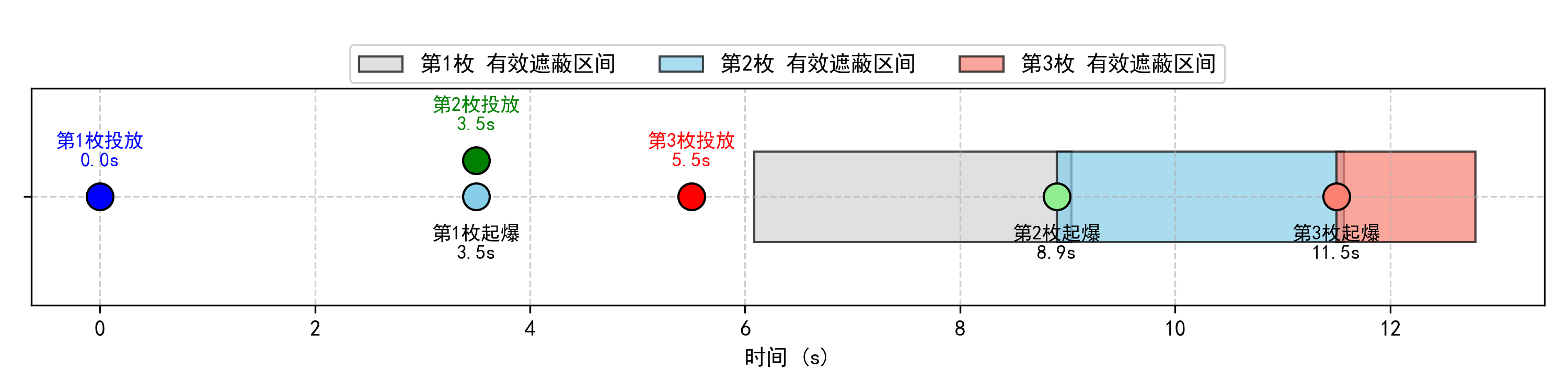
| Problem 3 | Single-aircraft three-missile coordination; MISOCP (second-order cone constraint model) and greedy scheduling | 6.712 s | Self-shielding duration of a single missile: 2.952 s / 2.672 s / 1.297 s; continuous shielding enhancement after coordination |
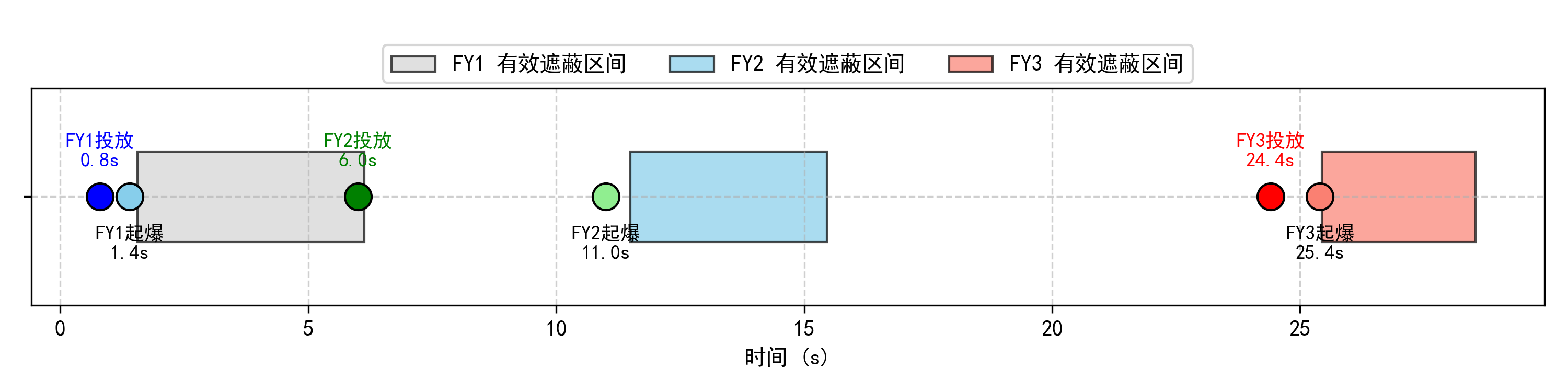
| Problem 4 | Three-aircraft single-missile coordination; hierarchical parallel search and combinatorial optimization | 11.630 s | Optimal shielding durations for FY1/FY2/FY3 individually: 4.580 s / 3.970 s / 3.110 s, respectively |
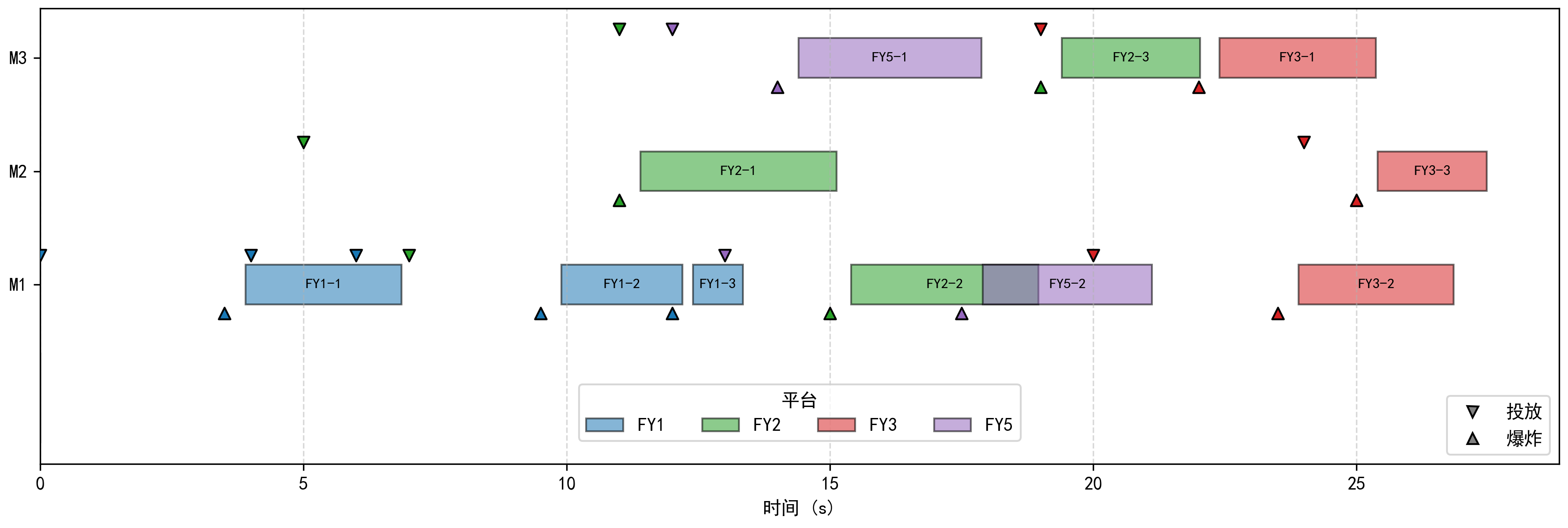
| Problem 5 | Five-aircraft multi-missile coordination; global aggregation and greedy scheduling | 26.954 s | Coordination among FY1, FY2, FY3, and FY5; FY4 was not deployed due to its low cost-effectiveness |
Key Illustrations
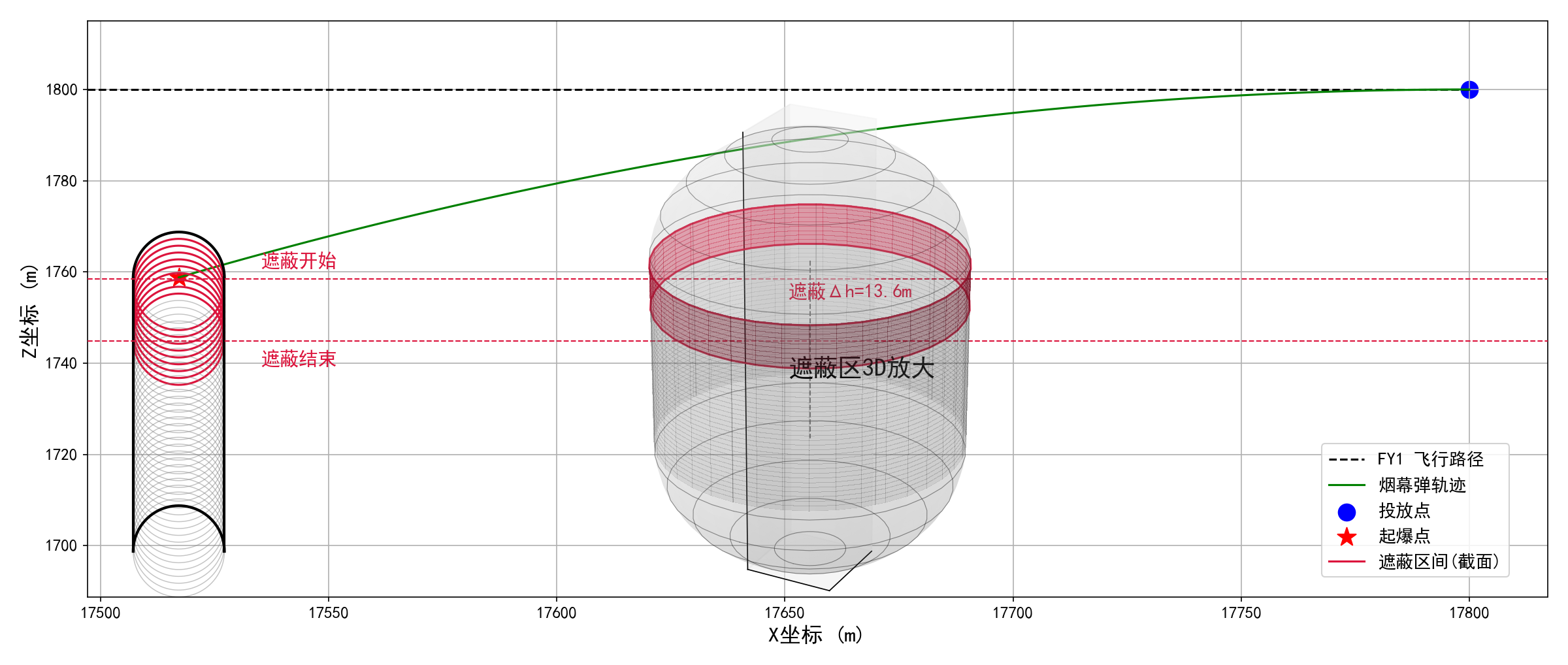
The following seven core figures are presented according to the logic of the paper, including modeling schematics and smoke screen/unmanned aerial vehicle scheduling diagrams based on computational results. Click on the images to enlarge for detailed viewing.
Model Evaluation
Advantage 1: Unification of geometry and physics
The kinematic evolution of missiles, UAVs, and smoke screens is integrated with geometric occlusion determination, ensuring the model is both interpretable and computationally tractable.
Advantage 2: Controllable solution efficiency
Through coarse-to-fine grids, early stopping mechanisms, and parallel computing, high-quality near-optimal solutions are rapidly obtained in high-dimensional parameter spaces.
Advantage 3: Scalability of coordination scenarios
From single-aircraft-single-munition to five-aircraft-multi-munition reuse within a unified framework, this demonstrates the method’s transferability in multi-aircraft coordination and multi-target scheduling.
Limitation: Global optimality and dynamic adaptability
Grid search carries the risk of local optima, and the model, based on fixed initial conditions and uniform motion assumptions, still requires an online correction mechanism for strongly dynamic disturbance scenarios.
Paper Resources
If the browser cannot preview PDF directly, use the "Open in New Window" button.