
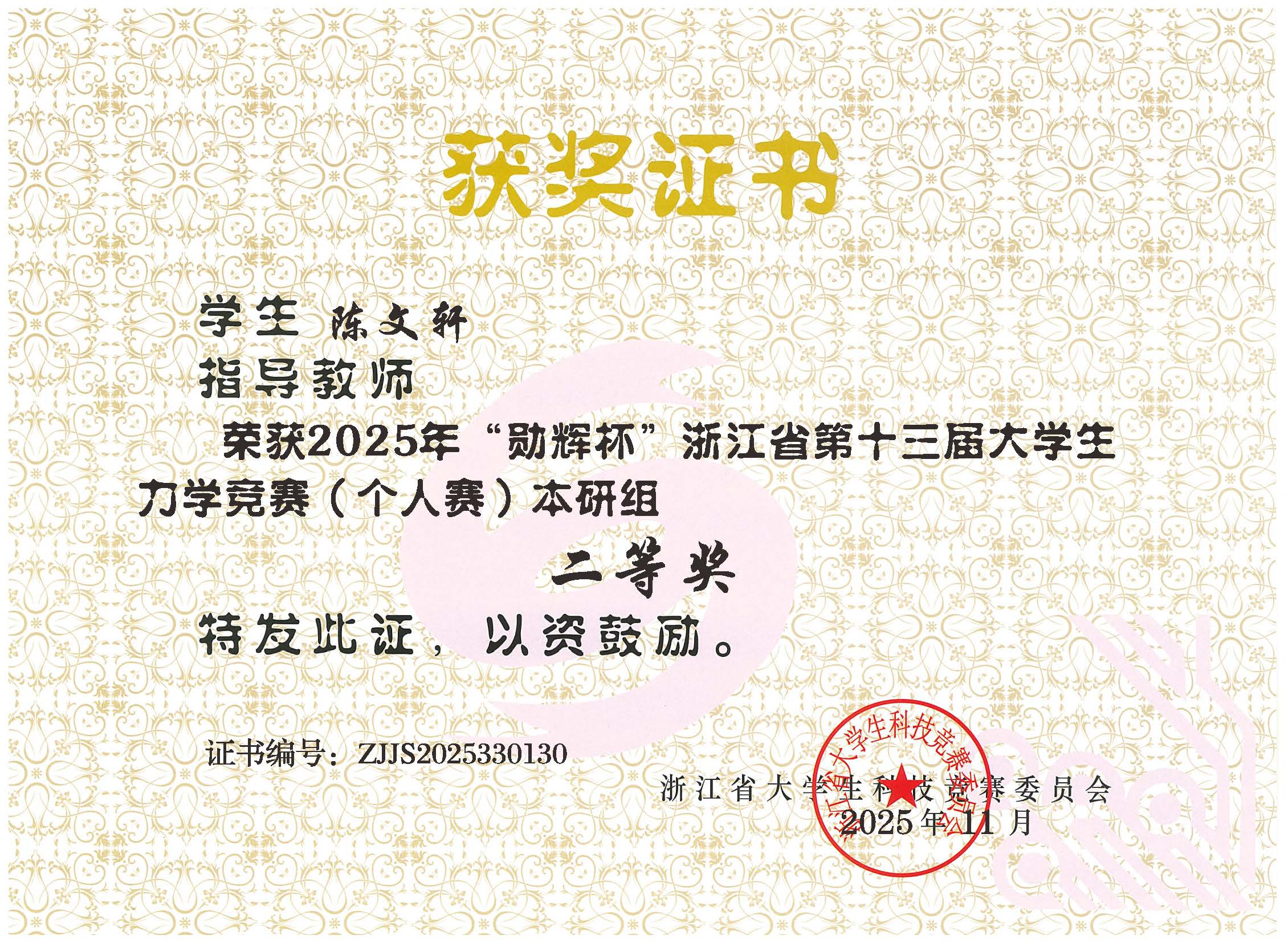
Cross-disciplinary three-week preparation: from barely qualifying within the university to winning a provincial award
Prior to this mechanics competition, I had not systematically studiedTheoretical Mechanics and Mechanics of Materials,nor were they part of my undergraduate major courses.Self-study for one week before the university-level competition to build a foundation + Targeted practice for two weeks between the university-level and provincial competitionsBased on the problem sets assigned by Professor Wang Yun, I continuously practiced and reviewed.ranking 36th at Hangzhou Dianzi University, barely qualifying (the last qualifying spot)—to the provincial competition,ranking 76th in the province (51st percentile),and winning the Provincial Second Prize.
Abstract
The mechanics competition was a typical interdisciplinary challenge for me: I had to quickly acquire foundational knowledge in Theoretical Mechanics and Mechanics of Materials within a short period and rapidly transform that knowledge into problem-solving ability. Through phased learning, targeted problem-solving, and systematic review of mistakes, I ultimately achieved a turnaround from "barely qualifying" to winning the "Second Prize in the Provincial Competition."This experience further convinced me that I possess the ability to rapidly establish a knowledge system in a new field and consistently deliver results.At the same time, it should be noted thatany competition involves an element of luck,and this is especially true for theoretical examination-based competitions. The final exam questions happened to suit my preparation, so my score was indeed higher than what my actual proficiency in mechanics would warrant.
University selection stage
The campus selection competition was the first hurdle. Sincemy academic background was not in mechanics (mechanics is not a core course in Electronic Information Engineering, and students in this major typically do not take mechanics courses),I relied primarily on intensive self-study over a short period to build the foundational knowledge. I ultimately ranked36th at Hangzhou Dianzi Universityand entered the provincial competition asthe last qualifier.On one hand, this result indicated that my ability was still in the catching-up phase; on the other hand, it made clear that I needed to implement a more intensive and targeted training regimen over the following two weeks.
Three-week preparation pathway
Week 1: Self-study foundation before the campus selection competition
I focused on supplementing core knowledge points in Theoretical Mechanics and Mechanics of Materials. The main task was to recall high school physics fundamentals (by then, I had not engaged with kinematics or mechanics for two years), extend from that foundation, and memorize basic mechanical concepts (such as torque and stress).
Weeks 2–3: Intensive training after the campus selection competition
During the two weeks between the campus selection competition and the provincial competition,I suspended all other tasks and concentrated solely on practicing mechanics problems.Thanks to current large language model technology, although these models cannot fully and accurately solve mechanics problems, they still provide useful references for many knowledge points and problem-solving approaches.
Driven by the coach's problem set
In collaboration with the senior mechanics coach at our universityProfessor Wang YunI worked through assigned exercises organized by topic, striving to fill gaps in conceptual understanding and address incompleteness in the knowledge system.
Focus of Learning Strategy
Targeted and goal-oriented, with high-frequency exam topics as the main threadPriority was given to ensuring stable scoring ability in force analysis, kinematic equation formulation, and common models in mechanics of materials (problems solvable directly through dimensional analysis, requiring no special techniques)As for complex concepts and problems such as deflection, a strategic decision was made to abandon them.
Provincial competition breakthrough and review
The final result of the provincial competition wasranking 76th in the province (51st percentile),receivingthe Second Prize in the Zhejiang Provincial Mechanics CompetitionFrom barely qualifying within the university to winning a provincial award, the key transformation was not merely an accumulation of practice problems, but the establishment of a pathway for rapid interdisciplinary learning: first grasping the core knowledge, then converting concepts into executable problem-solving actions through high-density training.
For a student with a background in Electronic Information Engineering, the significance of this award lies in demonstrating my foundational competence in the natural sciences and my ability to transfer knowledge across disciplines. My high school physics foundation provided significant support during this cross-disciplinary learning process, and further strengthened my confidence in pursuing advanced studies at the graduate level.
PDF Note Preview
This PDF is a compilation of learning materials for the mechanics competition, includingproblem-solving notesandand organized summaries of key knowledge pointsIf the browser cannot preview the file directly, please use the "Open in New Window" button.